
Shah Tables Bill to Remove Arrested Ministers
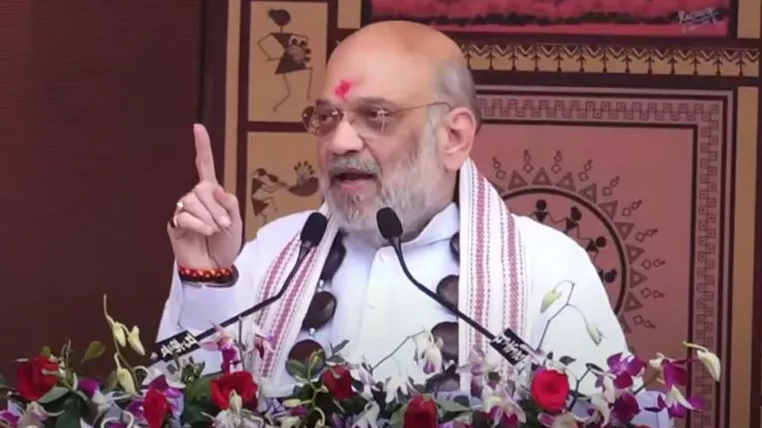
Delhi | News Desk: Union Home Minister Amit Shah on Tuesday introduced the 130th Constitution Amendment Bill, 2025 in the Lok Sabha. The bill proposes that Union, State, and UT ministers- excluding the Prime Minister and Chief Ministers, be automatically removed from office if arrested or in custody for 30 consecutive days on charges punishable with at least five years in prison.
The move follows controversy over the arrest of Tamil Nadu minister V. Senthil Balaji in a money laundering case. Currently, the Constitution allows disqualification only after conviction, not arrest.
Opposition leaders, including Abhishek Manu Singhvi and Manoj Jha, slammed the proposal as a tool to destabilize opposition governments through politically motivated arrests. Left leader Dipankar Bhattacharya called it a direct attack on democracy, warning of increased misuse of central agencies.
The bill is unlikely to pass in the Monsoon Session, which ends on August 21, but is expected to be sent to a select committee for review.
The amendment seeks to modify Article 75 of the Constitution, which deals with the appointment and responsibilities of ministers along with the Prime Minister.
According to the draft, if any Union, State, or Union Territory minister-excluding the Prime Minister or Chief Minister-is arrested and remains in custody for 30 days for an offense punishable with five years or more of imprisonment, they must be removed from office on the 31st day. The removal will be executed by the President on the Prime Minister’s advice.
This bill comes in the wake of the controversy surrounding the arrest of V. Senthil Balaji, a minister in Tamil Nadu’s DMK government. Balaji was arrested in a money laundering case, after which Governor R.N. Ravi dismissed him from the cabinet. Later, following his bail, Chief Minister M.K. Stalin reinstated him, prompting concerns from the Supreme Court. Balaji was eventually removed again during a cabinet reshuffle.
Shah had earlier informed the Lok Sabha Secretariat that during this Parliament session, the government would introduce three bills-The 130th Constitution Amendment Bill, 2025, The Jammu & Kashmir Reorganization (Amendment) Bill, 2025 and The Government of Union Territories (Amendment) Bill, 2025.
The ongoing Monsoon Session ends on August 21, leaving only two days for discussions. Until now, no constitutional provision allowed the removal of ministers, CMs, or the PM merely on the basis of arrest or custody, only a conviction could disqualify MPs and MLAs from their posts.
In the statement circulated to MPs, the government emphasized, Elected representatives embody the hopes and aspirations of the people. Ministers are expected to work in public interest, free from political gain. Ministers facing serious criminal charges can erode constitutional morality, good governance, and public trust. Hence, amendments to Articles 75, 164, and 239AA are being proposed to enable the removal of such ministers.
Opposition leaders fear the bill could be misused against political rivals. They point to recent arrests of Chief Ministers Arvind Kejriwal and Hemant Soren, which their parties claimed were politically motivated. Congress MP and senior lawyer Abhishek Manu Singhvi said in a social media post-“This is aimed at targeting the opposition. Arrest procedures lack consistency, and opposition leaders are disproportionately targeted. The new law would remove sitting CMs immediately upon arrest-an easy way to destabilize opposition governments.”
He also alleged that ruling party CMs never face similar consequences, highlighting bias in central agencies.
RJD MP Manoj Jha warned that the bill blurs the line between the accused and the convicted, saying-“The Supreme Court itself cautioned that the ED is becoming part of political games. Where the BJP cannot win elections, this is a tool to remove opposition leaders.”
Dipankar Bhattacharya, CPI(ML) General Secretary, called it a direct attack on parliamentary democracy, arguing that it will further enable the misuse of agencies like the ED, CBI, IT, and NIA.







