Dholkal Ganesh Idol: A Testament to Chhattisgarh’s Rich Cultural Heritage
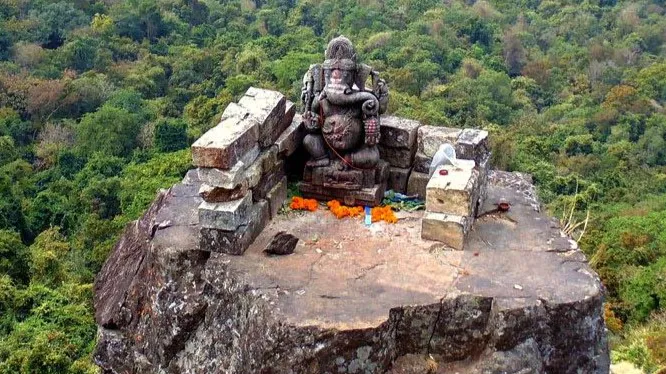
Dantewada | Correspondent: While cities across India mark Ganesh Chaturthi with vibrant processions and festive crowds, far away in the forests of southern Chhattisgarh, the celebration takes a quieter, more ancient form. Atop a 3,000-foot-high hill in Dantewada’s Bailadila range sits a lone idol of Lord Ganesha, known locally as Dholkal Ganesh, a figure of faith that has endured the passage of a thousand years.
Carved from a single block of granite and standing nearly three to four feet tall, the idol is believed to have been installed during the 10th or 11th century by the Chhindak Nagvanshi rulers who once governed parts of Bastar. The sculpture is striking not only for its antiquity but also for its unique features- a serpent carved across the belly, shackles in place of the sacred thread, and the deity seated in the relaxed lalitasana posture.
Lord Ganesha is depicted holding a parashu (axe) in his upper right hand, a broken tusk in his upper left hand, a rosary (akshamala) in abhaya mudra in his lower right, and a modak (sweet) in his lower left. According to archaeologists, no other idol of this kind exists anywhere in the Bastar region. With no temple structure surrounding it, the idol sits beneath the open sky, encircled only by forest and silence, making it one of Chhattisgarh’s most enigmatic heritage sites.
The region once known as Dantesh (Wada) later came to be called Dantewada. Within it lies a Kailash cave, tied to a deeply rooted belief: this is the very Kailash where a battle once took place between Lord Ganesha and Lord Parashurama. During the conflict, Ganesha’s tusk was broken and fell here, giving him the name Ekdanta (the one with a single tusk).
Even today, the route from Dantewada to Dholkal bears traces of this legend. Along the way lies the village of Paraspal, believed to be named after Parashurama, followed by Kotwal Para, where Kotwal means protector. Tribal communities recall how the sound of a priestess’s conch once echoed from the summit all the way down to the homes below.
Tradition holds that the idol was placed on such a high peak by the Nagavanshi rulers. A serpent symbol etched on Ganesha’s stomach is seen as their signature, perhaps deliberately inscribed to mark their lineage while consecrating the idol. To this day, tribal communities like the Bhogami climb to the hilltop to worship him, regarding Lord Ganesha as the guardian of the Dantewada region.
The Pilgrimage to Dholkal
Reaching the site is no small task. From Faraspal, a five-kilometre trek winds through thick forests, wild mogra groves, and the remnants of forgotten shrines. The climb demands both physical effort and spiritual reverence, often described less as a hike and more as a pilgrimage, a journey where devotion unfolds in silence and footsteps rather than spectacle.
In 2017, the Dholkal idol suffered a devastating blow when it was discovered broken and scattered down the slope. Authorities attributed the act to suspected Maoist groups, allegedly to deter tourism in the region.
The fragments were later recovered and painstakingly restored with the help of the Archaeological Survey of India and local administration. For local communities, however, the restoration was far more than technical, it was an emotional revival of their protector deity, a reaffirmation that the spirit of Ganesha still watched over their land.
As Chhattisgarh observes Ganesh Chaturthi this year, the Dholkal Ganesh remains seated high above the clouds, untouched by noise, yet deeply rooted in faith. In an age rushing forward with speed and spectacle, this ancient idol continues to embody something rare: stillness, memory, and the quiet strength of a god who never left his mountain.