
Mysterious Star-Like Object Emits Signals Every 44 Minutes
Mysterious Celestial Object in Milky Way Emitting Radio and X-Ray Signals Every 44 Minutes
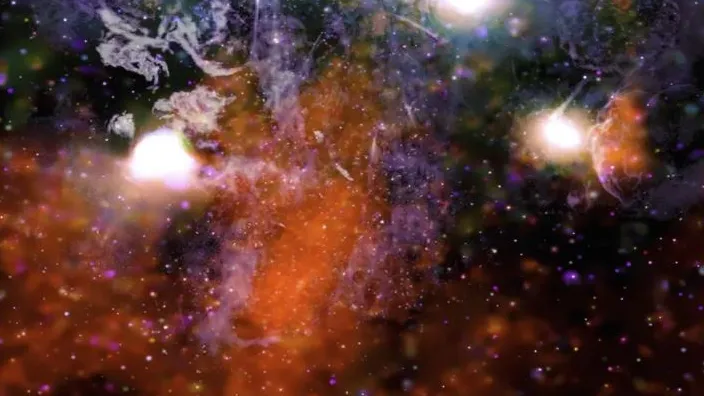
New Delhi | Desk: An international team of astronomers has discovered a mysterious and unusual celestial object within our Milky Way galaxy that emits both radio waves and X-ray radiation every 44 minutes.
This cyclical activity becomes particularly intense during periods when the object is highly active, suggesting a yet-unidentified cosmic mechanism.
Located approximately 15,000 light-years from Earth in a dense region of stars, gas, and dust within the Milky Way, the object has been named ASKAP J1832−091. Its discovery was made accidentally by NASA’s Chandra X-ray Observatory while it was observing the remnants of a supernova, the exploded remains of a massive star.
Lead researcher Ziteng "Andy" Wang from Curtin University in Australia noted that the object might be an ultra-magnetic dead star, such as a neutron star or a white dwarf. However, he also emphasized that it could represent something entirely new and previously unknown to astrophysics.
First of Its Kind
What makes ASKAP J1832−091 exceptional is that it is the first known long-period radio transient, a type of astronomical object that emits repeating radio signals over a period of minutes, to also emit X-ray radiation. This dual emission phenomenon has never before been observed in such objects.
The object's active phase lasted about one month, during which strong and consistent signals were detected. Outside of this window, it went completely silent in the X-ray spectrum. This behavior has raised the possibility that many more such hidden objects might exist in the universe, only detectable during short periods of heightened activity.
Despite intense analysis, scientists remain uncertain whether the object is physically linked to the nearby supernova remnant, due to ambiguities in measuring exact distances across such vast cosmic scales. (One light-year equals approximately 5.88 trillion miles.)
Scientific Implications
This discovery adds a new layer of complexity to the classification of stellar remnants. Scientists are currently debating two main hypotheses-It may represent a completely new category of astronomical object or it may be a known object type, e.g., a neutron star or white dwarf, displaying never-before-seen emission behavior.
As Wang puts it, “This discovery doesn’t solve the puzzle of these mysterious objects, it deepens it. But it takes us one step closer to understanding whether we’re witnessing a new class of objects, or an extreme version of something we thought we already understood.”
About the Chandra X-ray Observatory
NASA’s Chandra X-ray Observatory, launched in 1999, orbits thousands of miles above Earth. It is one of the most powerful X-ray telescopes ever built, designed to observe the hottest, most energetic, and violent phenomena in the universe, including black holes, supernovae, and neutron stars.
Other astronomers and astrophysicists around the world have expressed keen interest in ASKAP J1832−091. The periodic nature of its emissions has drawn comparisons to magnetars, highly magnetized neutron stars, though the 44-minute interval is much longer than known pulsation periods.
Some researchers also speculate that it could belong to a binary system, where one star’s magnetic field is influencing its companion in unpredictable ways.
The discovery was made using a combination of instruments, including the ASKAP radio telescope in Australia, and follow-up observations are being planned using telescopes in Europe, North America, and space-based platforms.
As the study continues, this object may not only rewrite our understanding of stellar evolution but also offer clues into how extreme physics unfolds in the most mysterious corners of our galaxy.







