
Protests disrupt Arcelor Mittal Project hearing in Dantewada
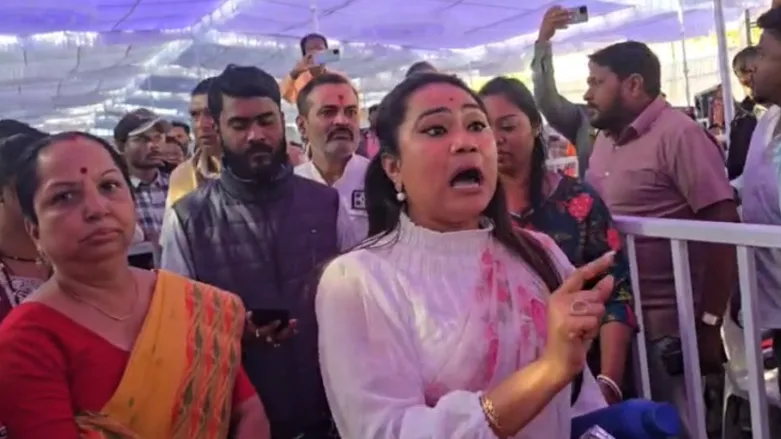
Ayushi Sharma | Raipur: A public hearing for environmental clearance regarding Arcelor Mittal Nippon Steel India Private Limited's proposed iron ore beneficiation plant, which aims to increase its capacity from 8 million tons per year to 12 million tons per year, was mired in controversy on Tuesday. Public representatives and leaders of various political parties strongly protested the arrangements made during the public hearing, calling it insulting treatment of the public.
The public hearing was attended by sarpanches (village heads) from more than a dozen gram panchayats, Janpad members, former and current representatives of the District Panchayat, and leaders of various political parties from the Bastar division. The purpose of the hearing was to listen to the opinions, objections, and suggestions of the people in the project-affected area, but the stage setup and the seating arrangements for the officials raised serious questions about the entire event.
Throne-like arrangement, public kept outside the barricade
The stage constructed for the public hearing was built at a considerable height. The Additional Collector and officials from the Regional Environment Protection Board were seated on the stage. A thick iron mesh was erected around the stage, completely enclosing it. The public and their representatives were made to stand outside this enclosure and speak through a microphone.
Many public representatives were offended by this sight. They said that it looked less like a public hearing and more like a royal court, where the officials were seated on a throne-like structure while the public was kept at a distance, outside the barricade.
Former District Panchayat President Tulika Karma's strong protest
During the public hearing, former District Panchayat President Tulika Karma expressed her anger. She strongly objected to the stage and the arrangements, saying that it looked less like a public hearing and more like "Akbar's court."
She said that in the environmental clearance process, officials should sit among the people and listen to their problems, not establish themselves on a high platform like kings.
Tulika Karma said that this kind of arrangement clearly shows that there is no intention of taking the public's opinion seriously. She boycotted the public hearing, calling it a blatant insult to the public and elected representatives, and walked out of the venue.
Questions raised about tribal rights
The Sarpanch (village head) of Kadapmal also registered a strong protest during the public hearing. He said that the tribals have the first right to the mountains, soil, and water of this region, but these resources are continuously being handed over to companies.
He questioned what the companies have given to the dozens of villages located below Iron Hill in the name of development.
Besides, he raised point stating the first right over the mountains, land, and water belongs to the tribals. What six-decades of long development have given the villages below iron-hill dust-filled air, red polluted water, anda life of hardship.
Fears beyond the plant site
This question gains importance as the company claims the proposed expansion will remain within the existing pkant area and will not involve new forest land.
Project documents state that the plant covers 39.838 hectares and the exapnsion will occur within these limits. However, tribal communities say environmental impacts do not stop at boundaries. Dust, pollution, depletion of water sources, waste generation, and increased traffic affect the villages far beyond the plant site.
The Company's executive summary notes that water consumption will increase from 12000 to 18000 cubic meters per day after the exapnsion, with water drawn from the Shabari River and Madadi Nala. This has heightened local anxiety, especially as the Indravati River already faces seasonal water scarcity and the Dankani-Sankani river is reportedly polluted due to mining activities. There is growing fear that the Shabri River will now face the similar pressure.
Public hearings or paper formalities?
Amid this, State Congress Committeee Joint General Secretary Uma Shankar Shukla described the environmental clearance process as a 'farce', alleging that approvals are granted in advance and public hearings are reduced to mere formalities. He said such an approach in a Fifth Schedule area goesagainst the spirit of the Constitution and undermines the trust of local communities.
Project documents also acknoweldge the presence of Schedule-I wildlife species such as leopards, sloth bears, sambar deer, pangolins, and propose wildlife conservation plan worth Rs. 80 lakh. While, this appears reassuring on paper, local leaders pointed to a rare shrimp species found in the Shabri river, stressing that conservation must extend beyond forests to rivers and acquatic life. Their demand is clear, not a single drop of water from the Shabari should be used for industrial purposes without a concrete conservation plan.
The company claims the expansion will generate 154 additional jobs, raising total employment to around 594, and that Rs. 10.81 crore has been spent on CSR activities over the past three years. Yet tribal representatives question whether employment and CSR spending can truly compensate for environmental damage and socio-cultural loss. For them, land, forests, and water are not resources alone, but the foundation of their existence.
The proposed expansion has thus brought to the fore a deeper democratic and environmental challenge in Bastar. The nature of the public hearing, the disconnect between officials and local communities, concerns over river ecosystems, and the anger voiced by tribal representatives all underline one reality: development cannot be judged by numbers alone. Without genuine and respectful participation of local communities, such projects risk becoming another chapter of injustice in Bastar’s history.







