
Where did the TB patients’ money go?
NPY payment on paper, not in reality
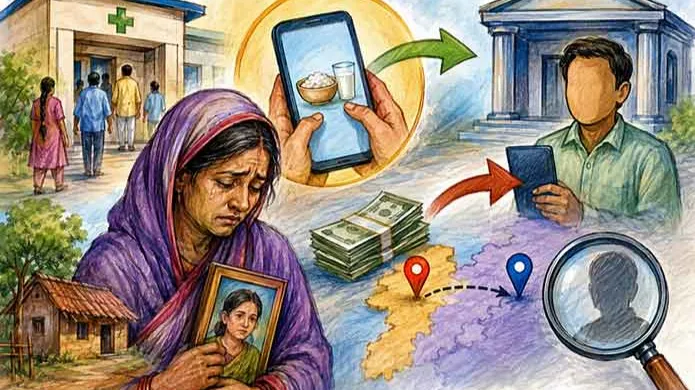
Raipur | Ayushi Sharma: For Pramila Khalkho, a resident of Ambatoli in the Kansabel area of Jashpur, Chhattisgarh, the year 2025 was a period suspended between illness and hope. It was in January that 42-year-old Khalkho visited Jashpur’s district hospital to get TB treatment, where she was informed that under a government scheme, she would receive ₹1,000 monthly in her bank account to cover nutritional needs during her treatment.
The amount was not huge, but for a poor family battling illness, even ₹1,000 a month holds significance.
Pramila likely hoped that the assistance would at least ease the burden of food expenses alongside her medical treatment. However, she passed away in December 2025 without ever receiving the funds she had been promised.
The story did not end there. Following her death, a review of records revealed a government entry showing a lump-sum payment of ₹6,000 made in her name in May 2025. In other words, the records indicated that six months' worth of nutritional assistance had been disbursed. Yet, the trail of the payment revealed a complicated situation: according to available documents, the money had been transferred to a different bank account in Masturi, Bilaspur district, located 207 kilometers away from Kansabel.
This raises a critical question: how did the funds sanctioned for a woman registered as a TB patient in Jashpur end up in an account linked to Masturi? And Pramila was not the only one.
Available documents indicate similar irregularities affecting at least 50 individuals in Jashpur, the home district of Chhattisgarh Chief Minister Vishnu Deo Sai. While government records listed the payments in the names of Jashpur TB patients, the funds were shown as transferred to bank accounts linked to other districts and even other states.
These records mention bank accounts associated with districts such as Raipur, Bilaspur, Raigarh, and Janjgir. In some instances, details regarding accounts linked to Delhi also came to light. Certain payments were recorded as lump sums of ₹6,000 indicating a record of six months' worth of assistance being disbursed at once.
However, the issue is not merely that the bank accounts were located in a different district. The real question is whether those accounts actually belonged to the patients in whose names the payments were recorded.
The names of some beneficiaries listed in the documents also appeared suspicious. Attempts to contact the mobile numbers associated with these names revealed that some numbers were switched off, while in other cases, it was found that the individuals concerned did not use those numbers.
This situation raises questions about the fundamental mechanism of the scheme through which TB patients across the country receive financial assistance for nutrition during their treatment.
It went from ₹500 to ₹1,000, but who actually received it?
For a long time, the fight against TB in India was perceived as being limited to disease detection, testing, and the provision of free medicines. However, over time, the deep link between TB and malnutrition became evident. Prolonged illness can deplete a patient's weight and strength, while poor nutrition can compromise the body's immune system.
Against this backdrop, the central government launched the Nikshay Poshan Yojana in April 2018. Under this scheme, patients notified under the National TB Elimination Programme receive direct financial assistance for nutritional support throughout their treatment period. Initially, this assistance was ₹500 per month. The government increased it to ₹1,000 per month effective November 1, 2024. According to official central government records, this amount is to be provided to the patient for the entire duration of the treatment.
While announcing this hike in October 2024, the central government stated that patients could now receive nutritional support ranging from ₹3,000 to ₹6,000 during the treatment period. At the same time, the government announced provisions for 'Energy-Dense Nutritional Supplementation' for patients with low BMI and the expansion of the Ni-kshay Mitra initiative. In other words, the ₹6,000 figure appearing in Pramila’s records is not unusual in itself; a lump-sum payment of ₹6,000 calculated at ₹1,000 per month over six months aligns with the scheme's provisions.
The real anomaly, according to available documents, is that the money did not reach the patient in whose name the payment was recorded. This was not merely a case of a complaint about "not receiving the money"; it was also a matter requiring an examination of the links between the beneficiary's records, their bank account, and the payment process.
Questions raised despite the digital system
The Nikshay Poshan Yojana incorporates a system for making payments via digital channels. Official documents from the Centre indicate that the Ni-kshay portal has been integrated with the Public Financial Management System (PFMS) to facilitate payments to eligible beneficiaries via Direct Benefit Transfer (DBT). The India TB Report 2024 also records that approximately ₹2,781 crore was disbursed to around 10 million (1 crore) beneficiaries under the NPY scheme between April 2018 and December 2023. According to the report, bank or post office account details for these beneficiaries were collected and linked (seeded) within the Ni-kshay system.
To further strengthen the payment mechanism, the government subsequently outlined measures such as integrating the Ni-kshay portal with PFMS and state treasury systems, as well as implementing digital reporting and payment monitoring via dashboards.
In this context, the questions arising from the Jashpur case become even more critical. If the system is digital, at what stage was the bank account linked to the patient's name verified? If the account belonged to a different person, how was it linked to the beneficiary's record? If the account details were correct but the payment went to a different account, where did the error occur during the payment process? And if the records showed the payment as completed, why were the patient and her family not informed?
These questions cannot be answered without an investigation, as the issue goes beyond simply determining the whereabouts of the ₹6,000 recorded in Pramila's name. The broader question is: if such a significant discrepancy can exist between the bank account registered for a patient and the account that actually received the payment, how many other records in Jashpur require re-examination?
Payment made on paper, but not to the patient
According to information that emerged in April 2026, a seven-member committee was constituted to investigate these alleged irregularities and was instructed to submit a report within 15 days. However, the investigation remains incomplete to this day.
The objective of an inquiry into government schemes is not merely to identify the level at which an error occurred. The investigation must also examine who prepared the records, how the beneficiary's identity was verified, on what basis the bank account was linked, which official or digital process approved the payment, and at what stage the payment was reconciled.
In the Jashpur case, this entire chain of events is crucial; if government records show a payment of ₹6,000 made to Pramila Khalkho, yet available documents indicate the funds went to a different account, simply tracing the bank account will not suffice. Interestingly, this is not an isolated case involving only Pramila; several similar instances have come to light in Jashpur.
A state government official associated with the Health Department, speaking on condition of anonymity, states: "The government's own framework includes digital systems, PFMS integration, and reporting mechanisms to track payments. According to the India TB Report 2024, the process for generating NPY installments was modified starting January 1, 2024, to expand coverage and reduce delays in processing benefits. This indicates a continuous effort to improve the system. However, the true test of any digital system lies with the end beneficiary did the money actually reach the patient's account?"
TB Patients Left Out of Nutritional Support
Data from the Union Ministry of Health indicates that in 2023, 38,924 TB cases were notified in Chhattisgarh, with 36,275 patients receiving at least one NPY payment. In 2024, 39,593 cases were notified, and 36,160 patients received at least one payment. In 2025, 39,365 cases were notified, yet the number of patients receiving at least one payment dropped to 27,056.
This means the gap between the 39,365 notified cases and the 27,056 recipients in 2025 indicates that only 68.7 percent of the patients received the money.
Data available for 2025 shows that 705,511 TB cases were notified in Uttar Pradesh, with 299,338 patients receiving at least one NPY payment. In Madhya Pradesh, these figures stood at 172,162 and 110,083, respectively. Rajasthan recorded 161,334 cases and 96,630 recipients. In Odisha, 59,916 cases were notified, and 48,130 patients received at least one payment. Chhattisgarh recorded 39,365 cases and 27,056 recipients.
Clearly, the decline observed in the 2025 figures for Chhattisgarh draws attention.
More questions, fewer answers
For that same year, Chhattisgarh’s government expenditure on the NPY was reported as ₹14.31 crore. For comparison, expenditure recorded was ₹55.01 crore in Madhya Pradesh, ₹36.15 crore in Maharashtra, ₹48.47 crore in Rajasthan, ₹25.59 crore in Odisha, and ₹141.76 crore in Uttar Pradesh.
Social activist and High Court advocate Priyanka Shukla says, “If the investigation into the Jashpur case is to be thorough, it must address at least a few fundamental questions. First, were the patients against whose names payments were recorded actually registered on the Nikshay portal for TB treatment? Second, based on which documents were the bank accounts linked to their names registered? Third, who are the holders of the accounts where the funds were deposited, and are they related to the actual patients? Fourth, was a single bank account linked to the names of multiple beneficiaries? Fifth, is the use of accounts linked to other districts or Delhi merely a coincidence, or is there a pattern behind it? Sixth, who was the ultimate beneficiary of the ₹6,000 payment recorded in Pramila’s name in May 2025? And seventh, why was the report not submitted on time, despite the directive for a seven-member committee to submit it within 15 days?”
Pramila can no longer answer this question herself; she passed away in December 2025. Yet, the record of the ₹6,000 payment made in her name remains a lingering question. Government records state that the payment was made. The family’s claim, and indeed government documents, state that the money was not received. Meanwhile, available documents reveal a third picture: the funds were transferred to a different account.
The objective of the Nikshay Poshan Yojana was to provide financial assistance for nutrition to TB patients during their treatment. According to the Central Government, between April 2018 and December 2025, a total of ₹4,322 crore had been distributed to 1.35 crore TB patients across the country under the scheme. However, the events in Jashpur have raised serious questions about this scheme; after all, for a TB patient, the scheme does not merely signify a ‘payment’ logged on a portal. It represents money reaching the household during the illness funds that allow for the purchase of food alongside medication.
The discrepancy between the official records and the reality in Pramila’s case lies at the heart of this entire story. Until the Jashpur inquiry reveals what actually transpired in Pramila’s case and in the more than 50 other alleged instances, the question will persist: why did the patients remain empty-handed when government records showed the payments as complete?







