Kerala HC rejects unrecognised CV Raman University degree: student’s LL.B. admission cancelled
Beware! Kerala High Court's ruling on unrecognised CVRU degrees from Chhattisgarh is shocking.
Raipur | Correspondent: If you are currently pursuing or have already obtained a degree through 'private' or 'distance mode' from Dr. C.V. Raman University (CVRU) in Bilaspur, Chhattisgarh, or any other private university, this news might come as a major shock.
While the case itself is not new, the observations made by the High Court hold lasting significance.
A division bench of the Kerala High Court delivered a landmark and exceptionally stern verdict, exposing the entire practice of DR. C.V. Raman University issuing degrees without the requisite approval from the University Grants Commission (UGC).
As a result of this court ruling, years of hard work by a promising student went to waste, and his admission to an LLB program was cancelled midway.
This is not merely the story of one student whose prospects have been ruined; it is a wake-up call for millions of students across the country who, in their pursuit of an ‘easy’ degree, blindly place their trust in the claims made by private universities.
What is the whole story? How did a single degree derail everything?
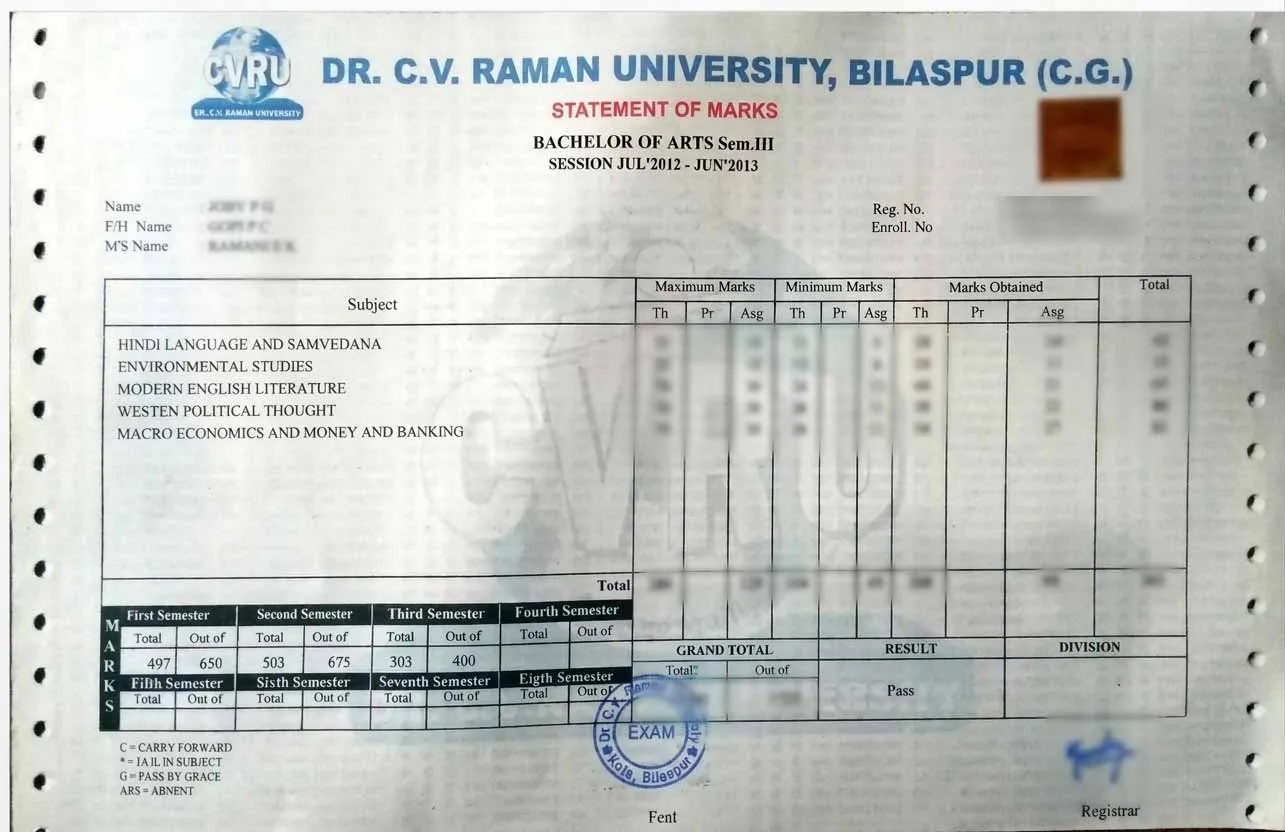
This sensational case revolves around 57-year-old Jackson Das T., a resident of Kochi, Kerala. Aspiring to pursue a career in law, Jackson Das completed a B.A. in History through the ‘private mode’ (distance/external study) at Dr. C.V. Raman University, Bilaspur, Chhattisgarh, between 2016 and 2019. He appeared for all the examinations and earned his degree with an impressive score of 68.8 per cent.
On the strength of his marksheet and degree certificate from C.V. Raman University, Jackson Das secured admission to the three-year LL.B. programme at the School of Legal Studies, under the prestigious Cochin University of Science and Technology (CUSAT), Kerala. He completed his first semester and even appeared for the examinations in May 2022.
However, during a thorough verification of his academic credentials, a startling revelation came to light, leaving everyone stunned.
How a single letter shattered his dream of becoming a Lawyer
On October 14, 2022, the Controller of Examinations at CUSAT sent a letter to the Director of the Law Department. It explicitly stated that the BA degree obtained by Jackson Das from Dr. C.V. Raman University did not have the approval of the University Grants Commission (UGC).
Following this communication, Jackson Das’s first-semester results were withheld, and he was issued a show-cause notice asking him to explain why his admission to the LL.B. programme should not be cancelled.
When Jackson Das appealed for recognition of his degree, the university responded firmly on December 9, 2022. It clarified that, during the 2016–2017 academic session, the UGC’s Distance Education Bureau (DEB) had not granted Dr. C.V. Raman University approval to offer a B.A. (Bachelor of Arts) programme.
C.V. Raman University’s ‘trickery’ and the UGC’s startling revelation
When the case reached the Kerala High Court, the duality of C. V. Raman University was exposed. The University's administration handed over a mere letter and tried to escape.
The University claimed that it had issued the degree in accordance with a decision by its 'Academic Council' and under Section 22 of the UGC Act, 1956; therefore, it asserted that the degree was entirely valid.
But when the UGC filed its official counter-affidavit in court, all the claims made by CV Raman University fell flat.
The UGC made three major revelations before the court
1. Permission was granted for only 23 courses; B.A. in History was not among them: The UGC clarified that it had authorized C.V. Raman University to offer only 23 specific programs via distance mode. No permission was ever sought or granted for the B.A. (History) degree that the university awarded to the student.
2. Blatant violation of regulations: The UGC informed the court that no private university is permitted to unilaterally offer degrees in courses of its own choosing through the 'distance mode.' Prior approval for each course is mandatory.
3. Prohibition on operating outside state boundaries: The UGC clarified that no state private university in Chhattisgarh is permitted to establish study centers or off-campus centers outside the state's borders, nor can it grant affiliation to any college located outside the state.
High Court’s firm stance: “A degree obtained without proper recognition cannot be validated”
Appearing on behalf of the student, Jackson Das, senior counsel argued before the Court that the student had duly complied with all the prescribed requirements, including payment of fees, appearing for examinations, and successfully passing them. He contended that if the university lacked UGC recognition, the student should not be held responsible for the university’s failure to obtain such recognition. The student’s career, he argued, should not be jeopardised because of an institutional lapse.
Initially, in December 2024, a Single Judge of the Kerala High Court dismissed the petition. Aggrieved by the decision, the student preferred an appeal, being W.A. No. 148 of 2025, before a Division Bench of the High Court.
On February 18, 2025, the Division Bench, comprising Justice Anil K. Narendran and Justice Murali Krishna S., delivered its judgment, dismissing the student’s appeal.
The Court clarified that where a degree or course lacks the requisite UGC recognition, a student cannot claim the right to pursue further higher education, including an LL.B. course, based on such a degree. In the eyes of the law, a degree that is not legally recognised cannot be treated as a valid qualification for pursuing further studies.
The most important lesson for students: 4 precautions to take before obtaining a degree
This judgment from the Kerala High Court (2025:KER:13319) serves as a wake-up call for students across the country. In many parts of India, a network of agents and "study centers" has emerged, claiming to provide "private" or "distance" degrees, all from the comfort of your home. If you wish to safeguard your money, time, and future, keep these points in mind:
• Do not rely solely on a university’s letterhead: Even if a university claims to be recognized and issues a degree, that document may ultimately prove to be nothing more than a worthless piece of paper. Private universities often mislead students by citing Section 22 of the UGC Act.
• Verify independently via the UGC-DEB website: Before enrolling in any distance or private program, visit the official website of the UGC’s Distance Education Bureau (DEB). Check whether the university holds valid recognition for the specific subject in the year you are enrolling.
• Avoid obtaining a "private" degree from another state: If you reside outside of Chhattisgarh, do not make the mistake of obtaining a degree from a private university in Chhattisgarh through a distance program or a "study center." Under rulings from the Supreme Court and various High Courts, such degrees are subject to immediate cancellation during the verification process for government jobs or higher education admissions.
• The "regular" mode is the safest path: If you choose to study at a private university, ensure you pursue your degree as a regular student attending classes and taking examinations at the university’s main campus. Furthermore, always verify that the program has received approval from the relevant regulatory council (such as AICTE, NCTE, or BCI).
Remember, a degree is not just a piece of paper; it represents the culmination of your life’s hard work and investment. Just 10 minutes of due diligence before enrolling can save you a lifetime of regret and the hassle of running around to courts.