
Distance: the hidden barrier to Tuberculosis care
Distance that delays TB treatment in Bastar
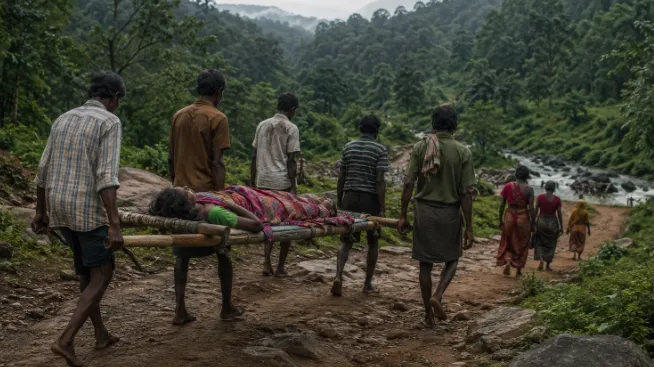
Raipur | Ayushi Sharma: At dawn on April 26, 2026, Binagunda villagers lifted 42-year-old Lakshmi Mandavi onto a cot and began walking towards the health centre. They had already waited for nearly two hours for an ambulance, but none arrived. With no other option, they carried her over 19 kilometres through forested terrain to the Chhotebethiya BSF camp, hoping to find help. From there, an ambulance finally took her to the Civil Hospital in Pakhanjur. By the time she reached the hospital, Lakshmi had died.
Lakshmi lived with her two daughters in the Pakhanjur area of Kanker district after losing her husband in 2018. Her health problems had begun much earlier, in March 2022, there came a time while collecting mahua in the forest. She would often feel weak, experience persistent coughing and breathlessness, but would recover after resting for a while. As the months passed, these episodes became more frequent, and she gradually started losing weight.
Because of her own negligence in her health adding to financial constraints and the remoteness of healthcare facilities, her family could not get her proper diagnosis in time. Primary healthcare facilities near the village were limited, and reaching a hospital required travelling long distances over difficult terrain.
It was only when her condition worsened considerably that an ASHA worker seeing her symptoms collected her sputum sample and transported it to a testing centre, where she was diagnosed with Drug-Resistant Tuberculosis (DR-TB).
Since her husband's death, Lakshmi had been solely responsible for raising her two daughters and managing the household. As her illness progressed, travelling repeatedly to distant health facilities became increasingly difficult. The long distance to hospitals, delays in accessing medicines, interrupted treatment and the social isolation she experienced from fellow villagers gradually took a heavy toll on her health. By April 2026, the journey to reach healthcare had become as dangerous as the disease itself.
Lakshmi's death is not an isolated tragedy. Across the tribal villages of Bastar, one of the greatest obstacles to tuberculosis care is not simply the disease but the distance patients must travel to access diagnosis and treatment.
Distance beyond kilometres
In many parts of India, especially Chhattisgarh, the biggest challenge is often not the disease itself but the long and difficult journey to healthcare. According to The Lancet, people travel nearly 15 kilometres even for basic medical care and more than 40 kilometres when they need to be admitted to a hospital. In Chhattisgarh, reaching a doctor or hospital is still a major struggle. Despite government claims of improving healthcare, the reality on the ground is different. Many hospitals do not have enough doctors. Where doctors are available, medicines may be missing. And even where medicines are available, diagnostic facilities are often lacking.
The study found that only 30 percent of elderly people in Chhattisgarh can access healthcare within 10 kilometres of their homes. This means that seven out of every ten elderly people must travel much farther, even when they are seriously ill. Their journey is rarely on smooth highways. Instead, it often involves walking through forests, crossing hills, travelling on unpaved roads and, at times, crossing rivers.
The Lancet report also shows that the farther people live from a hospital, the less likely they are to seek treatment. While healthcare use is much higher within a distance of 10 kilometres, it drops sharply once the distance exceeds 30 kilometres. In Chhattisgarh, this does not mean people are careless about their health. It means many have simply become exhausted by the long journeys, repeated waiting and the difficulties of navigating the healthcare system.
Distance here is not only a geographical challenge; it is also a social one. A large proportion of Chhattisgarh's elderly population belongs to tribal communities, for whom hospitals are not only far away but also unfamiliar places. The language is different, the surroundings are unfamiliar and communication with healthcare workers is often difficult. In such circumstances, many people find it easier to live with illness than to make the difficult journey for treatment. The report also found that women, elderly people living alone and poorer households are affected the most by distance. All three groups make up a significant share of Chhattisgarh's population, meaning the impact of distance is felt not only in statistics but also in people's everyday lives.
The real question in many villages is not whether treatment is free. It is much simpler, "Will I even be able to reach the hospital?" For many families across Chhattisgarh, that question remains unanswered.
Poor roads, unreliable public transport, limited ambulance services and the concentration of better healthcare facilities in only a few district hospitals and medical colleges make the problem even worse. For many families, reaching a hospital means losing a day's wages, borrowing money to pay for transport or delaying treatment until the illness becomes unbearable. As The Lancet points out, the farther healthcare is, the less likely people are to seek it not because they do not want treatment, but because the journey itself becomes the biggest barrier.
But in Bastar, distance cannot be measured in kilometres alone.
In cities, travelling 20 kilometres may take less than an hour. In the remote villages of Bastar, however, the same distance can mean walking for several hours through dense forests, crossing rivers and streams, waiting for the only shared vehicle that operates that day or paying for costly private transport when no government vehicle is available. In many interior villages, mobile phone networks are unreliable, making it difficult to call an ambulance or seek help during an emergency. In many cases, patients have to be carried on cots for several kilometres before they can reach the nearest health centre. These delays often mean that patients reach medical care too late, and some die before reaching the hospital.
The situation becomes even more difficult during the monsoon. Flooded rivers and muddy roads often cut off entire villages, making travel almost impossible. For families that survive on daily wages, every hospital visit means paying for transport and food while also losing a day's income. For a person with tuberculosis (TB), this journey is not made only once. It must be repeated over several months for diagnosis, medicines, follow-up examinations and monitoring of treatment. In Bastar, therefore, distance is measured not only in kilometres, but also in time, lost wages, physical exhaustion and delays in receiving lifesaving care.
One such story is that of 28-year-old Saraswati Oyam from Barsur, an interior village in Dantewada district.
Saraswati gave birth to her first child in 2023, two years after her marriage. The baby was born malnourished, largely because Saraswati herself had long suffered from malnutrition. Her family's poor financial condition meant that nutritious food was often beyond their reach. Even today, malnutrition remains a common problem in many villages of Bastar due to a lack of proper and balanced nutrition.
After the birth of her child in February 2025, Saraswati began experiencing persistent weakness and fatigue. Gathering the courage, she told her husband about her condition. Like many tribal families, they first sought help from a traditional healer.
Traditional healers have no formal medical training, but their deep connection with the indigenous communities they are often the preferred healthcare providers in many indigenous communities because they are accessible and trusted. But Saraswati's condition did not improve. Nearly four months passed before the family decided to approach the public health system.
Her health gradually deteriorated. She stopped eating properly, became increasingly weak and withdrew from social life, often hiding the severity of her illness from her family.
Eventually, she was taken to Primary Health Centre, where a sputum examination was conducted. Nearly a week later, the results confirmed that she had Drug-Resistant Tuberculosis (DR-TB).
This marked the beginning of an even more difficult journey.
Treatment may be free, but access is not
Although tuberculosis medicines are provided free under the National TB Elimination Programme (NTEP), accessing treatment was anything but free. Every visit required Saraswati and her husband to spend an entire day travelling to the Designated Microscopy Centre (DMC), the most peripheral diagnostic unit responsible for sputum testing before samples are referred to higher-level facilities.
Reaching the PHC itself was exhausting. The journey from their village over uneven terrain often consumed an entire day. Her husband had to accompany her each time, meaning he lost a day's wages while transport costs added to the family's financial burden.
Tuberculosis treatment is not a one-time hospital visit but a long process that lasts at least six months and even longer for patients with Drug-Resistant Tuberculosis (DR-TB). Diagnosis requires sputum testing through molecular tests such as CBNAAT or TrueNat, followed by repeated visits for medicine refills, follow-up examinations, sputum monitoring, nutritional support and management of side effects. For patients in Bastar, each of these visits often means walking long distances, arranging transport, losing daily wages and spending hours travelling through difficult terrain. As a result, distance becomes a recurring barrier throughout treatment, delaying care and increasing the risk of interrupted treatment.
Long road to diagnosis
For Saraswati, the journey involved much more than travelling to a hospital. Before leaving home, she worried about her young child, unfinished household work and the physical strain of travelling despite being seriously ill. Every hospital visit became a struggle physically, mentally and financially.
The healthcare system often made the situation worse. Even after reaching the hospital, healthcare workers were sometimes unavailable, patients had to wait for hours, medicines were occasionally out of stock, or they were asked to return on another day.
As a result, despite travelling long distances to reach Dantewada district hospital, Saraswati sometimes returned home without receiving complete care. These repeated interruptions made maintaining uninterrupted treatment increasingly difficult.
While tuberculosis medicines are free, the hidden costs of treatment remain enormous. Every visit requires transport expenses, the loss of daily wages and someone to accompany the patient. For families surviving on daily incomes, these indirect costs often delay diagnosis and interrupt treatment. The burden falls disproportionately on tribal women.
Nutrition also plays a crucial role in tuberculosis care, and Chhattisgarh continues to face the twin burden of TB and malnutrition.
Women in tribal villages are responsible for cooking, collecting firewood and water, working in the fields and caring for children and elderly family members. Travelling long distances to health facilities often means leaving these responsibilities behind. Many women also depend on male family members to accompany them, making treatment dependent not only on their own health but also on someone else's availability and the family's finances.
The challenge becomes even greater during pregnancy and after childbirth, when women are already nutritionally vulnerable. Long journeys discourage timely diagnosis and regular follow-up, causing many women to seek care only after symptoms become severe. This not only reduces the chances of recovery but also increases the risk of transmission within households.
Distance is not a one-time obstacle but a recurring one throughout tuberculosis treatment. Patients must travel repeatedly for sputum examinations, molecular tests such as CBNAAT or TrueNat, chest X-rays, medicine refills, monitoring treatment response and managing side effects. For patients with DR-TB, these visits become even more frequent because treatment is longer and more complex.
Monsoon, Conflict and the Cost of delay
During the monsoon, villages across Bastar become partially cut off as streams overflow, kutcha roads become impassable and public transport is disrupted. Journeys that appear short on paper often take several hours on foot or require multiple changes of transport. Health workers say seasonal isolation frequently results in missed appointments, delayed diagnosis and interruptions in treatment.
These interruptions have serious consequences. Tuberculosis treatment requires uninterrupted medication for several months. Missing doses or delaying follow-up increases the risk of drug resistance, forcing patients into longer, more toxic and less successful treatment. Experts also point out that distance delays diagnosis itself. In remote tribal communities, limited awareness, dependence on traditional healing and the absence of nearby diagnostic facilities mean many patients enter the formal health system only after the disease has advanced.
For many years, large parts of Bastar were also affected by Left Wing Extremism, making regular health surveys, outreach programmes and disease surveillance difficult. Health experts say this has contributed to limited information about the burden of tuberculosis in some of the most remote tribal communities, making timely intervention even more difficult.
Tuberculosis is often described as a curable disease. But in Bastar, cure depends not only on medicines. It depends on whether a patient can cross forests, afford transport, leave work for another day, and reach a health facility before the disease advances. Until healthcare reaches people instead of expecting people to reach healthcare, distance will continue to decide who receives treatment in time and who does not.
Access to healthcare remains a challenge
Dr. Saket Kumar, the TB Nodal Officer for Dantewada, explains, "Tribal women often avoid informing their families when symptoms of illness appear. Many do so out of fear of social stigma, taunts from others, or the worry of becoming a burden on their families. For countless women, TB is not merely a disease but a social challenge. Although anyone can contract TB, social pressures and gender-based discrimination often lead women to conceal their symptoms and delay treatment, thereby putting their lives at greater risk."
He notes that tribal women in Chhattisgarh are known for their hard work. Living in remote forest areas, they often rely on traditional herbal remedies for minor ailments. Consequently, they tend to overlook persistent TB symptoms, assuming they are not serious.
Kumar adds, "When women from these remote communities face more serious health issues, their families usually take them to traditional healers first. This often delays proper diagnosis and treatment, causing the condition to worsen before they can even reach a healthcare center."
While the government claims that health experts are striving to bridge the gap between tribal communities and healthcare by organizing camps near villages efforts that have yielded some success many villagers still fail to reach appropriate healthcare facilities.
Clearly, for the tribal people of Chhattisgarh, this distance is effectively a matter of life and death a predicament for which there appears to be no immediate solution.







