
A letter from Paris- TEEJAN BAI, INDIA
Synonym to Pandwani, Teejan Bai
Raipur | Correspondent: A letter was sent to India from Paris, the capital of France. The letter neither mentioned the village, the post office, nor any address, it simply read: "Teejan Bai, India."
Remarkably, the letter reached its intended destination, a small village in Chhattisgarh named Attari. This was not just a coincidence but a testament to the identity of an unschooled folk artist who had earned it through her sheer talent.
Rising from the small village of Attari to reaching the global stage, Teejan Bai was more than just an artist. She had become an ambassador of India's folk culture.
Today, her passing is a synonym of Chhattisgarh losing one of its voices.
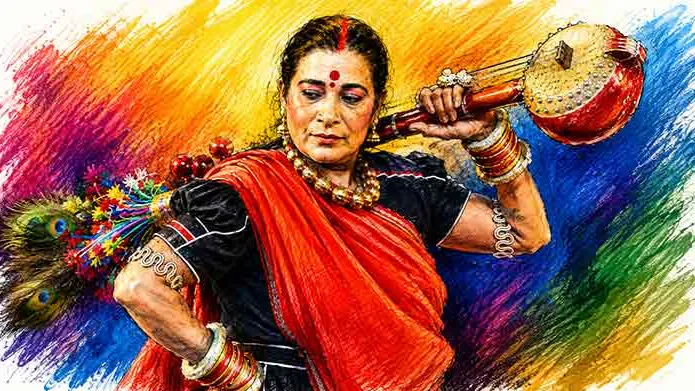
The world knew her as a Pandwani singer, yet just to label her art merely as 'singing' would be an injustice. The moment she stepped onto the stage, she transformed into a storyteller, an actor, a musician, and the character themselves all rolled into one.
The 'Tamboora' in her hands would morph at times into Bhima's mace, at others into Arjuna's bow, or even into a symbol of the battlefield. As her facial expressions shifted, the characters of the 'Mahabharata' would come alive before the audience's eyes. Whether or not the language was understood, the emotions resonated with every viewer. That is why audiences in European concert halls listened with the same rapt attention as the villagers gathered in the chaupals of Chhattisgarh.
Today, the mere mention of Pandwani instantly brings Teejan Bai's reminisce to mind; the circumstances were vastly different when she began her journey. At that time, Pandwani was considered a folk narrative confined primarily to rural areas. There were also strict boundaries for women; they were expected to perform while seated, using limited gestures. Acting on stage and embodying the story with one's entire physical being was largely considered the exclusive domain of male artists.
Teejan Bai was the first to challenge this tradition. She broke away from the custom of singing while seated and began performing standing up. She brought the characters of the Mahabharata to life not merely through words, but through acting and body language. This distinctive style of hers gave a new identity to the Kapalik form of Pandwani; eventually, this very style became her signature.
Ironically, the artist who introduced the world to this new style of Pandwani was herself unaware for years that the genre she performed was known as the Kapalik style. It was only during an event at Bharat Bhavan in Bhopal that she was told, for the first time, that her performance differed from the traditional Vedmati style. By then, she had already won over thousands of admirers.
Her success was not the result of institutional training; there was no music school, no formal theatrical training, and no academic study of literature. Her greatest classroom was village life. She learned the episodes of the Mahabharata not from books, but by listening to others. When her mother’s uncle, Brijlal Pardhi, sang Pandwani, young Teejan would sit at a distance and memorize the entire narrative; the emotions embedded in the words became etched in her memory alongside the lyrics.
Her family’s financial situation did not allow for thoughts of pursuing art. They worked as farm laborers and, in their spare time, made brooms and mats from date palm and chhind (wild date) leaves to sell in the market. Teejan was also engaged in this work from a very young age.
Singing 'Karma', 'Dadariya ', and 'Sua' while working in the fields was her passion. She often won local singing competitions, yet no one imagined then that this girl would go on to become one of India's most renowned folk artists.
Her personal life was marked by constant struggle. She was married during her adolescence but found no stability in her married life. Although she later remarried, conflicts regarding her art persisted. Her family wanted her to confine herself to domestic life, whereas for Teejan Bai, Pandwani had become as essential as breathing.
One day, during a stage performance, her husband created a scene he publicly began behaving violently, abusing and humiliating her.
While this incident could have shattered any artist, for Teejan Bai, it became the turning point that led to the most significant decision of her life. She left home, carrying only a few rations and accompanied by her two children. There was no certainty about the future, yet she held a firm belief that if her voice carried truth, there surely would be a way.
It was this conviction that led her to the village of Chandkhuri. There, she performed Pandwani before the villagers. It was the first time that locals had witnessed a woman presenting the Mahabharata with such boundless energy and dramatic flair. By the time the performance concluded, news of her talent had spread across the entire region. The village headman honored her, arranged for her meals, and organized a series of performances at the village gathering place. The storytelling continued for three days, followed by a seven-day stint in another village, and eventually, an eighteen-day continuous recitation of the Mahabharata.
Gradually, her fame transcended the borders of the state. When Habib Tanvir, a renowned theatre artist from Chhattisgarh, saw her perform, he invited her to Bhopal. She subsequently received an offer to work with his troupe, Naya Theatre. Although she rehearsed for the stage for a while, she soon realized that her true calling was not conventional theatre, but Pandwani. She chose the path of folk art over a formal acting troupe, a decision that would later mark one of the most significant turning points in the history of Indian folk art.
Her fame gradually transcended the boundaries of the state. When Habib Tanvir, a theatre artist from Chhattisgarh, saw her performance, he invited her to Bhopal. Later, she received an offer to work with the 'Naya Theatre' troupe. She rehearsed for theatre for a while but soon realized that her true stage was not the conventional theatre, but Pandwani. She chose folk art over an acting institution. This decision would later prove to be one of the most significant turning points in the history of Indian folk art.
Subsequently, her performances began taking place across the country. Her reach extended from performing at the residence of the then Prime Minister Indira Gandhi to appearing in Doordarshan’s acclaimed serial, Bharat Ek Khoj. Then, invitations from abroad began to arrive. The 'Festival of India' held in Paris brought her global recognition.
She was nervous the first time she boarded an airplane. Seeing the aircraft flying amidst the clouds, she felt as though she were embarking on a journey to the celestial abode of the gods. Upon reaching a foreign land, she also worried about how people unfamiliar with her language would comprehend her storytelling. However, the thunderous applause following her performance assured her that the true language of folk art is not words, but emotion.
It was from this point that Teejan Bai’s identity expanded beyond the borders of Chhattisgarh to the entire world. Pandwani was no longer merely a folk art form, it had become an integral part of Indian cultural identity. At the heart of this transformation was that woman from Atari village, someone who had never studied from school textbooks yet brought the Mahabharata to life through her voice in a way that captivated the world.
Even after gaining national and international acclaim, the simple village woman within Teejan Bai, who had witnessed poverty up close, remained unchanged. There came a time when this artist, who performed across the globe, accepted a Class IV job at the Bhilai Steel Plant to secure a steady income. Her role involved serving water to people. Many found it strange that an artist honored on international stages was working as a humble employee in a government undertaking. Yet, Teejan Bai never felt uncomfortable about it.
Her greatest quality was that fame did not change her. As impressive as she appeared on stage, she became equally at ease the moment she stepped off it. There was no affectation in her conversation, no ostentation in her attire, and no artificiality in her demeanor. She often used to say that an artist's true strength lies within, not in their clothes or the stage lights.
Gradually, Teejan Bai became a prominent cultural icon of Indian folk art. She began receiving invitations to almost every major cultural event in the country. Her performance in Doordarshan’s acclaimed series Bharat Ek Khoj introduced her to audiences who had previously been unfamiliar with Pandwani. Her international tours also increased steadily; she represented Indian folk art in numerous countries, including France, Switzerland, Germany, Italy, and Britain. Despite differences in language and culture, her performances resonated deeply with audiences everywhere. She believed that the greatest strength of art lies in the fact that it transcends the need for translation.
As her popularity grew, so did the accolades she received. The Government of India honored her successively with the Padma Shri, Padma Bhushan, and finally, the Padma Vibhushan. The Sangeet Natak Akademi Award accorded institutional recognition to her art, while Guru Ghasidas University and Indira Kala Sangeet University conferred honorary D.Litt. degrees upon her, acknowledging that this woman, despite lacking formal education, was a living university in herself. She demonstrated that knowledge is acquired not only through books but also through experience and dedicated practice.
Over time, her story began to reach the younger generation as well. A few years ago, a film based on her life was announced. She had hoped to see her journey portrayed on the big screen, but the project did not materialize. Nevertheless, extensive research was conducted on her biography, and her name began to feature prominently in academic studies on folk art at universities both in India and abroad.
With advancing age, health issues began to arise. She suffered a heart attack in 2018. Although doctors advised rest, she returned to the stage after a brief interval. For her, performing was not merely a profession but a way of life; she continued to sing *Pandwani* as long as her health permitted.
However, life also confronted her with personal tragedies that were difficult to overcome. She lost two of her sons very early. The death of her eldest son, in particular, shook her to the core. According to her family, she lost her former zest for life after this incident; she became much quieter than before.
In the meantime, she also suffered a stroke. Gradually, her mobility became restricted. The artist who once stood on stage for hours, bringing the battle of the Mahabharata to life, found herself confined to her bed. Her memory began to fade as well, family members recounted that during the final stages of her illness, she would often speak like a child, as if life had completed a full circle and returned to the innocence where it had begun.
For a period during her illness, her government pension was also suspended. It was only after the matter became public that the administration took action and reinstated the pension. A medical team was dispatched for her treatment. On the occasion of the Chhattisgarh State Festival, Prime Minister Narendra Modi personally inquired about her well-being, following which she was admitted to AIIMS, Raipur. Although she returned to her village after treatment, her health never fully recovered. Ultimately, after a long illness, she breathed her last.
Tijan Bai’s passing is not merely the loss of an artist, she transformed the perception of Indian folk arts, which were previously viewed as having a limited scope. She demonstrated that if a performance is sincere and the art possesses substance, a village dialect can be just as impactful in international auditoriums as the language of a major city.
She also proved that traditions survive only when there is the courage to experiment. Had she succumbed to the social constraints of her time, Pandwani might well have remained confined to a narrow sphere. She performed standing up, integrated acting into the storytelling, and elevated the Mahabharata from a mere religious narrative into a vibrant tale of human emotion.
Today, whenever a new artist in the villages of Chhattisgarh picks up the tambura, Tijan Bai’s influence is present in the background. Any discussion of Pandwani is incomplete without her. She did not merely carve out an identity for herself; she paved the way for future generations. Time will march on; new artists will emerge, and new voices will be heard, yet Teejan Bai’s place in the history of Indian folk art will remain enduring. The way she wove the scent of the soil, the sweetness of the folk dialect, and the epic saga of the Mahabharata into her voice will continue to inspire generations to come. Perhaps this is an artist’s greatest achievement: though the physical body eventually fails, their art lives on forever in the memory of time.
Important key dates
1956 – Born in Atari village, Durg district.
Age 12 – First marriage.
Age 13 – First public Pandwani performance in Chandkhuri.
7 July 1986 – Began employment at Bhilai Steel Plant.
1988 – Performed at the Festival of India in Paris; awarded the Padma Shri.
1988 – Performed in Doordarshan’s *Bharat Ek Khoj*.
1995 – Sangeet Natak Akademi Award.
2003 – Awarded the Padma Bhushan and a D.Litt. from Guru Ghasidas University.
2007 – Nritya Shiromani Samman.
2017 – Awarded a D.Litt. from Indira Kala Sangeet Vishwavidyalaya.
2018 – Suffered a heart attack; subsequently returned to the stage.
2019 – Awarded the Padma Vibhushan.
2023 – Death of son Shatrughn; subsequently suffered paralysis.
5 July 2026 – Passed away.







