As Delhi chokes, eyes turn to China’s air strategy
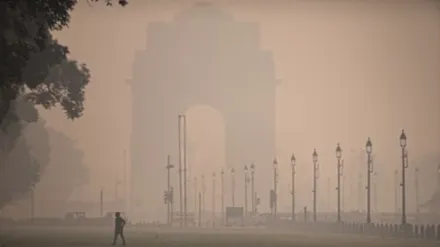
Beijing | Desk: As India's capital, Delhi, once again engulfs dense smog, experts and the media are turning their attention to China's successful air pollution control model. Recently, Yu Jing, spokesperson for the Chinese Embassy in India, expressed his eagerness to share China's journey toward "blue skies" on social media.
On Thursday, Delhi's overall Air Quality Index (AQI) was recorded at 264, which falls in the "poor" category. According to The Economic Times, air pollution has become an annual problem in Delhi with the onset of winter.
In 2013, China released the Action Plan on Air Pollution Prevention and Control, establishing a systematic and effective framework. According to Jia Weili, a professor at Huzhou University, China has developed several important and replicable methods. These include:
Scientific and efficient monitoring system: Accurate identification and control of pollution sources.
Transition to clean energy sources: Making energy sources more environmentally friendly.
Optimizing industrial structure: Improving the layout and operation of industries.
Regional joint prevention mechanisms: Pollution control through inter-regional cooperation.
China's success demonstrates that economic development and environmental management can go hand in hand, allowing developing countries to avoid the traditional path of "polluting first, then cleaning up."
Similar Challenges, Shared Solutions
Both India and China grapple with pollution sources such as crop burning, vehicle emissions, and industrial activities. Professor Long Xingchun of Sichuan International Studies University pointed out that China has extensive expertise in areas such as energy substitution and improving heating equipment, especially the coal-to-gas transition, which could be highly relevant to India.
However, experts believe that India does not need to copy the Chinese model exactly, given the differences in their economies and political systems. But, as The Economic Times put it, "India cannot be China, but it can learn important lessons."
Cooperation in air pollution control will not only help India save time but also open new avenues for rebuilding mutual trust. China's experience makes clear that air pollution is a long-term battle that requires strong political will and sustained investment from the government.